soundstream
Overview
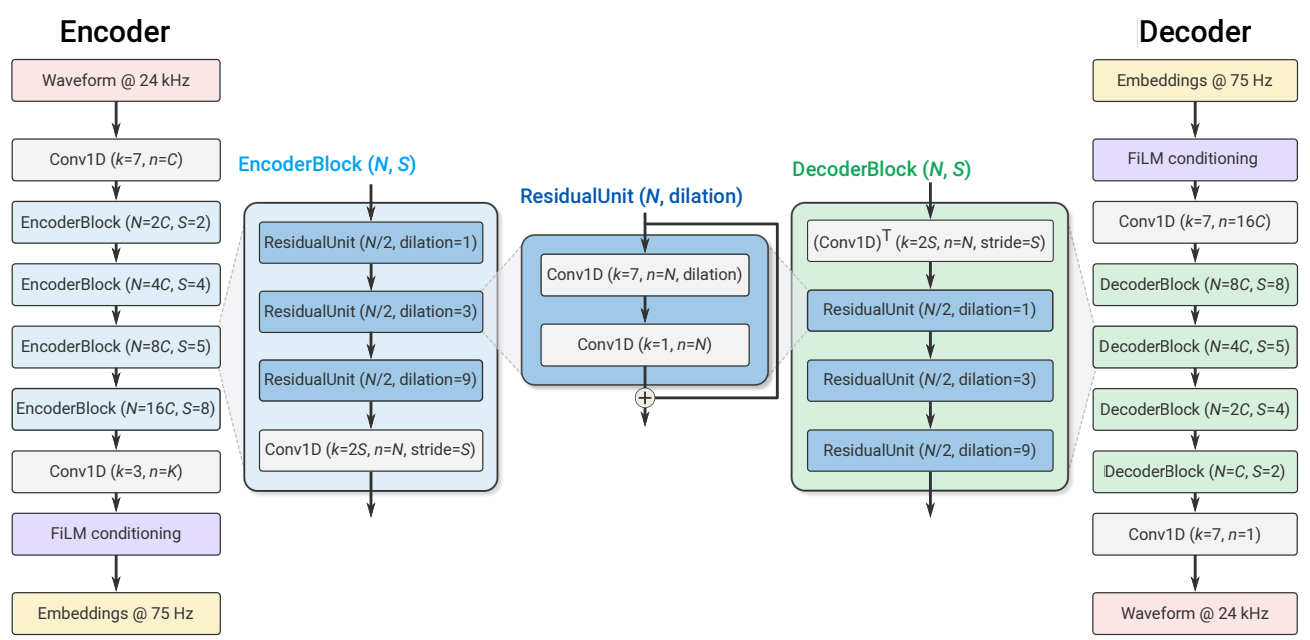
This repository implements the Soundstream neural audio codec from scratch in pytorch, staying as true as possible to the paper. We provide an implementation of the model in model.py and training code in train.py.
Dataset
We use the LibriTTS dataset, specifically the train-clean-100 subset. It can be downloaded and used in pytorch with the following line:
libritts_dataset = torchaudio.datasets.LIBRITTS('.', download=True)
Training
Traning is done a single Nvidia L40S GPU with 8 CPU threads. 7 threads are used for dataloading.
We first did generator warmup ( by calling generator_warmup() in train.py) for 50k iterations (~ 7-8 hours). Parameters for training were
batch_size=128,
max_grad_norm=0.5,      # gradients are clipped to avoid excessively large updates
warmup_steps=1000,      # number of warmup steps for linear warmup schedule
G_lr=2e-4,              # learning rate
G_betas=(0.9, 0.99),    # adam optimizer betas
rq_ema_gamma=0.95,      # vector quantizer codebook exponential moving average update gamma
use_quantizer_dropout=True, # whether to use quantizer dropout
vq_num_groups = 2,             # number of groups for grouped RVQ
C=32,                       # soundstream channel parameter
weights=(0., 0., 1.0, 1.0, 1.0), # (adversarial loss, feature loss, multi_spectral loss, reconstruction loss, commitment loss)
We then followed with adversarial training (adversarial_training() in train.py) for another 80k iterations (~ 4-5 hours).
batch_size=16,
max_grad_norm=0.5,
G_lr=1e-4,
D_lr=1e-4,
G_betas=(0.9, 0.99),
D_betas=(0.5, 0.9),
update_D_every=1,                   # update the discriminator every ___ iterations
update_codebook_every=8,            # update the RVQ codebooks every ___ iterations
rq_ema_gamma=0.95,
use_quantizer_dropout=False,
vq_num_groups=2,
C=32,
weights=(1.0, 0.1, 0.01, 1.0, 1.0), # (adversarial loss, feature loss, multi_spectral loss, reconstruction loss, commitment loss)
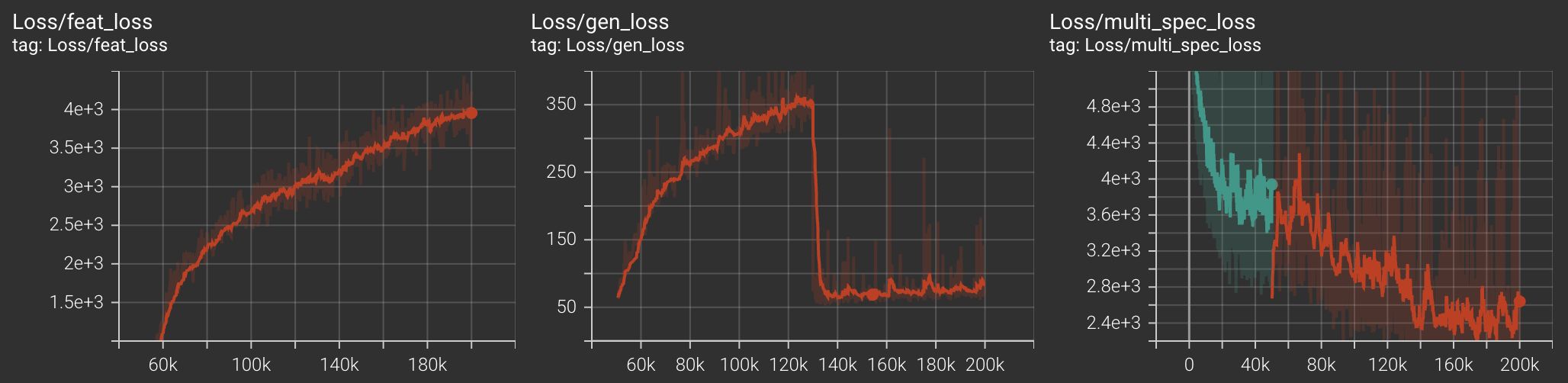
Lastly, we dropped the feature loss weight by a factor of 10 and trained for another 70k iterations (~ 4 hours).
batch_size=16,
max_grad_norm=0.5,
G_lr=1e-4,
D_lr=1e-4,
G_betas=(0.9, 0.99),
D_betas=(0.5, 0.9),
update_D_every=1,                   # update the discriminator every ___ iterations
update_codebook_every=8,            # update the RVQ codebooks every ___ iterations
rq_ema_gamma=0.95,
use_quantizer_dropout=False,
vq_num_groups=2,
C=32,
weights=(1.0, 0.01, 0.01, 1.0, 1.0), # (adversarial loss, feature loss, multi_spectral loss, reconstruction loss, commitment loss)
🎧 Real vs. Fake Audio Samples
We take 100 test samples from the dev-clean subset of LibriTTS for testing. We report a ViSQOL score which is calculated as the mean of MOS-LQO scores of the 100 samples. Not sure why the ViSQOL score is well below the reported number by the authors. Insights into why are welcome.
| Real Audio | Iteration No. | Fake (Generated) Audio | VISQOL |
|---|---|---|---|
| 🔊 Real 50k | 50k | 🤖 Fake 50k | |
| 75k | 🤖 Fake 75k | ||
| 100k | 🤖 Fake 100k | ||
| 130k | 🤖 Fake 130k | ||
| 200k | 🤖 Fake 200k | ||
| Best | 🤖 Fake Best |
Training Curves
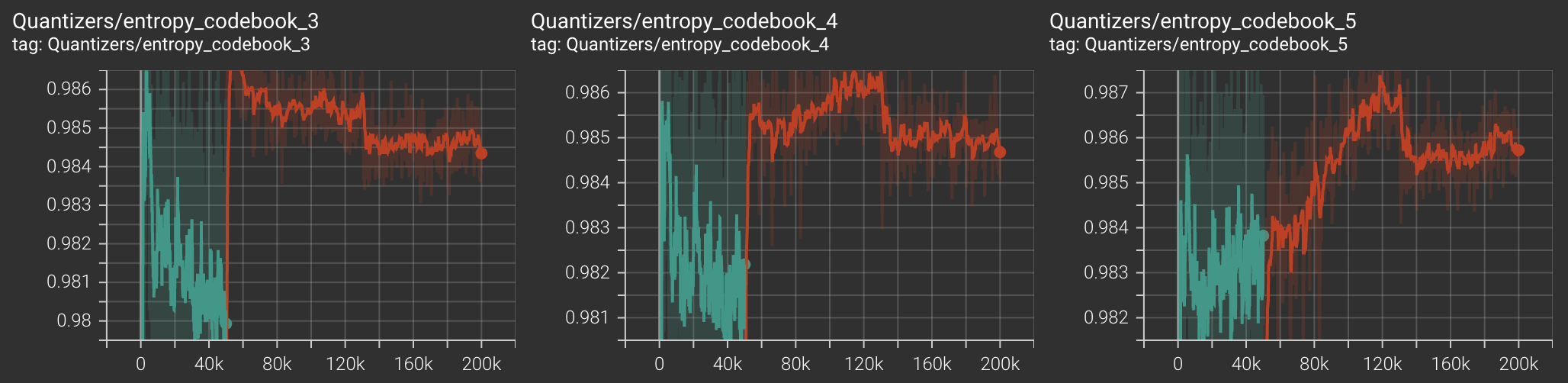
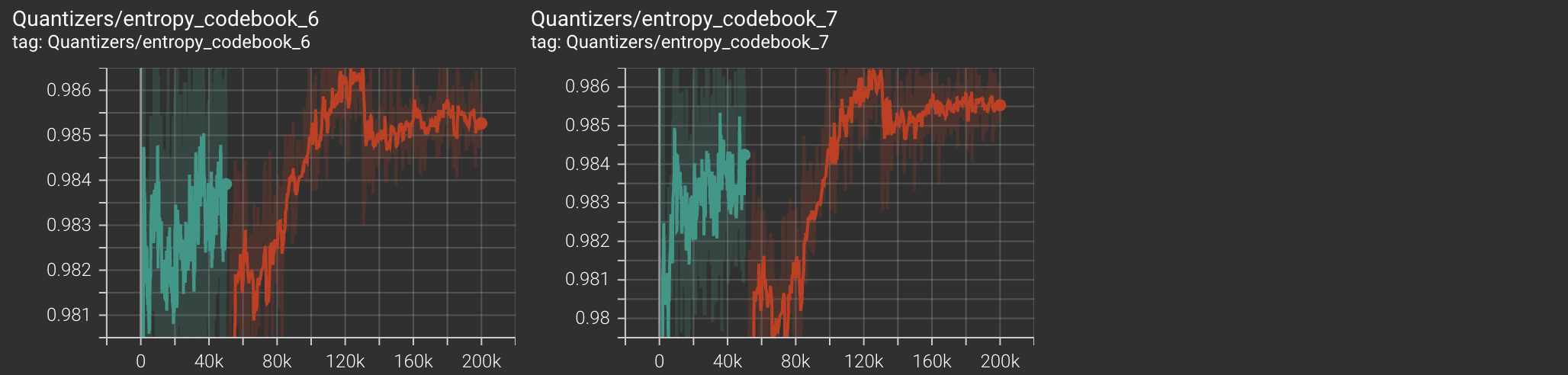
For codebook diversity metric, score of 1 implies codebooks are used uniformly (GOOD). Score of 0 implies only one codebook vector is being used (BAD).
| Metric | |
|---|---|
| Loss | 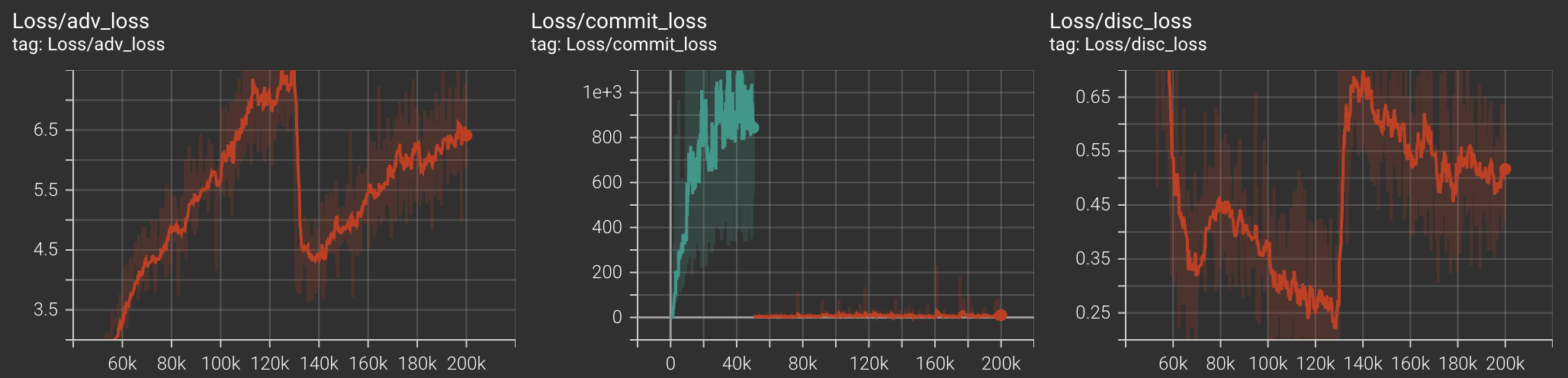 |
 |
|
| Encoder Embeddings L2 Norm | 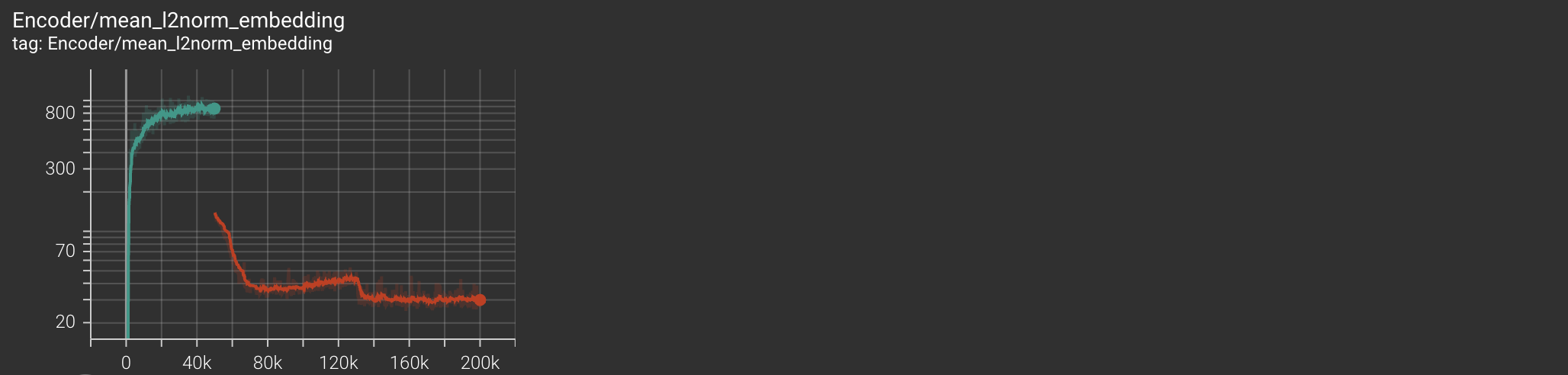 |
| Codebook Diversity | 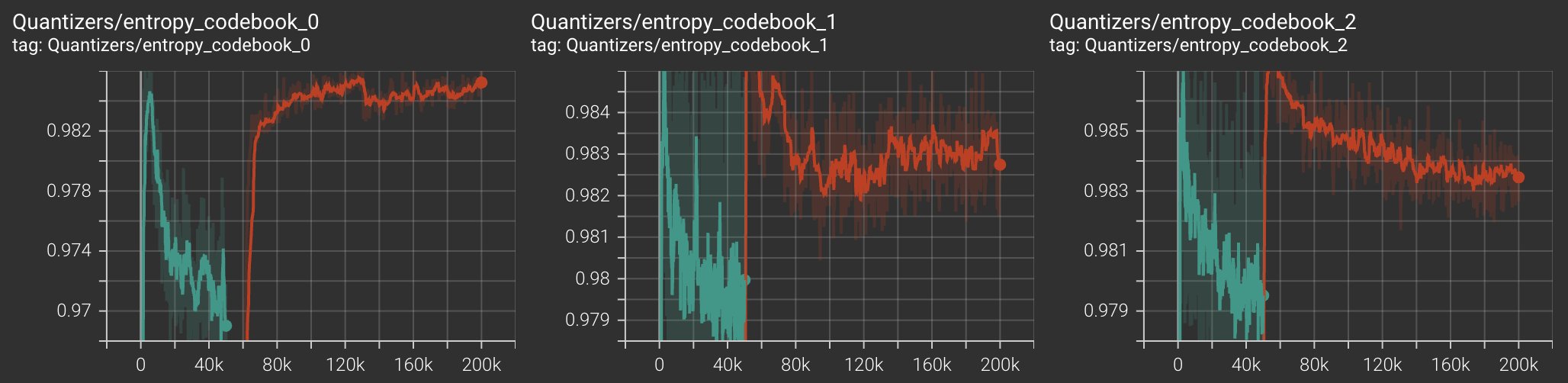 |
 |
|
 |
|
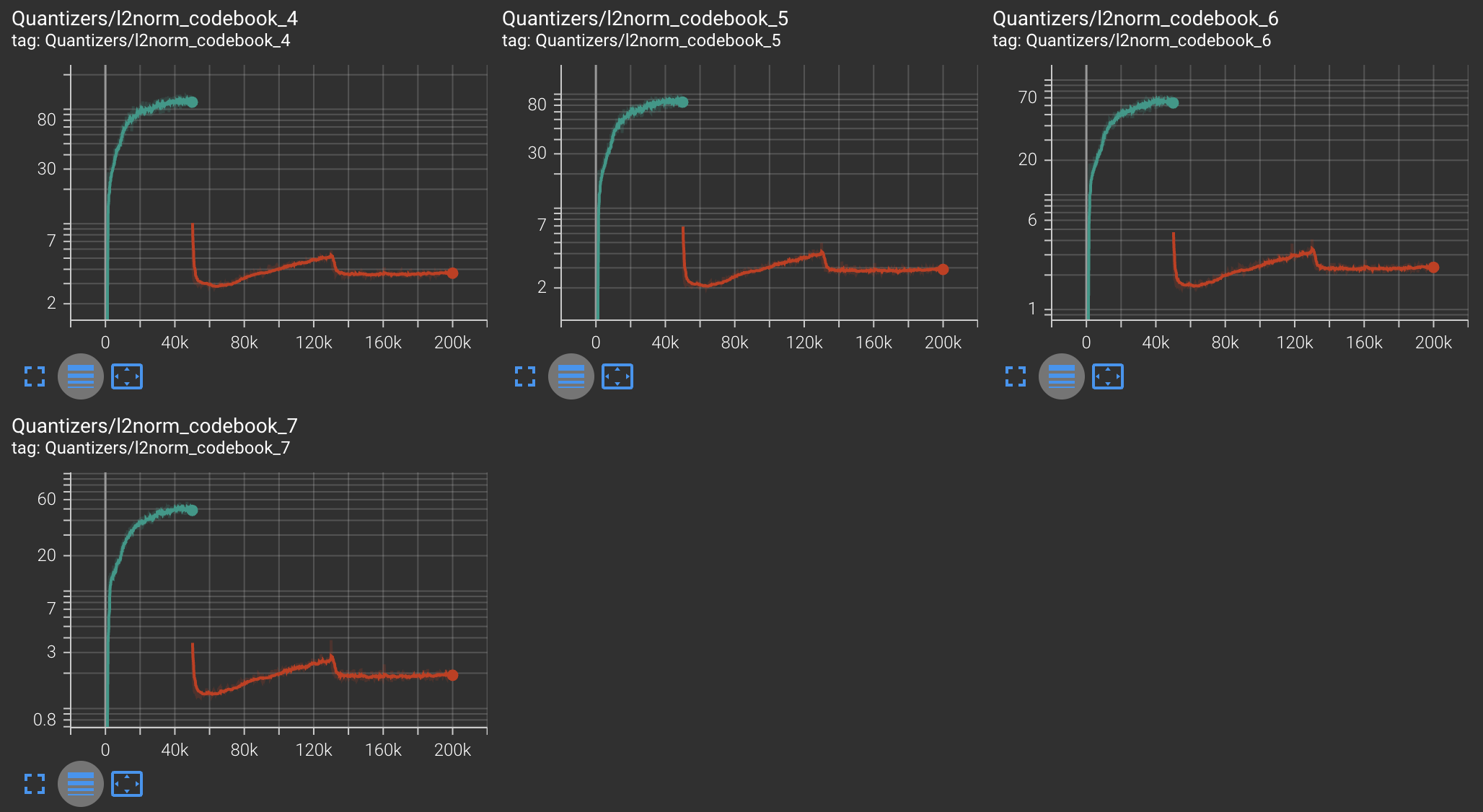
| Codebook Mean L2 Norm | 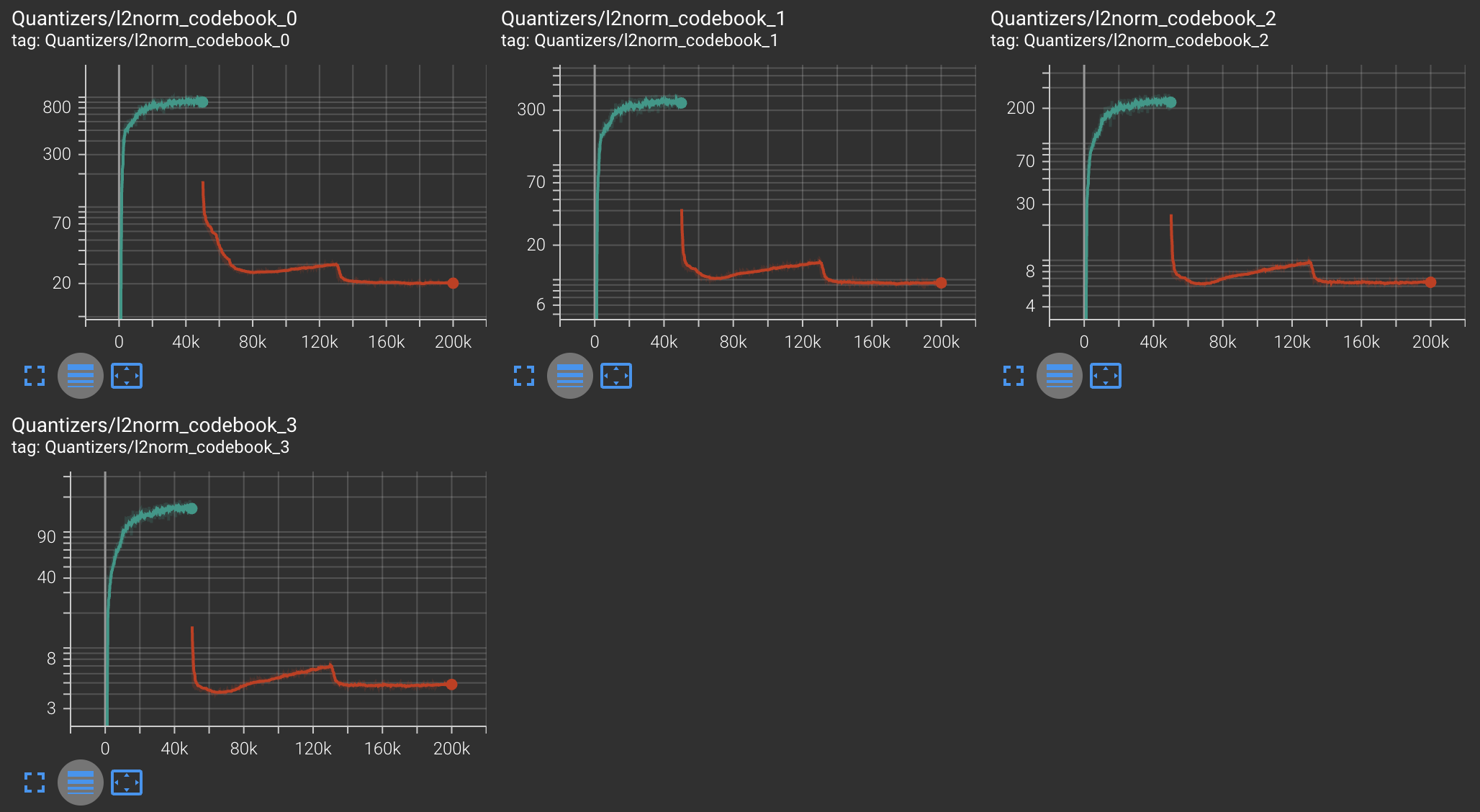 |
 |
Training Tips
- ensure that the product of
batch_sizeandupdate_codebook_everyis equal to 128. Anything less than this and we experience the encoder embeddings explode as training progresses. - the feature loss weight and multispec loss weight should be dynamically adjusted. In practice, if you see a declining multi_spec_loss, this leads to better sounding audio, even at the expense of feature loss. That is why we reduced the feature loss weight by a factor of 10 at iteration number 130k.
Checkpoints
We include two checkpoints that we found during training and had the smallest value of the multi_spec_loss. We also include 50k, 130k, and 200k checkpoints.