Four Fundamental Subspaces
In this note we cover the four fundamental subspaces of a linear transformation that is learned in linear algebra: The null space, row space, column space, and left null space.
Consider an $M \times N$ matrix $\boldsymbol{A}$. The four fundamental subspaces are:
Null Space
Define the null space as the set of all vectors $\boldsymbol{z} \in \mathbb{R}^N$ that get mapped to the zero vector by the matrix $\boldsymbol{A}$:
\[\text{Null}(\boldsymbol{A}) \triangleq \{\boldsymbol{z} \in \mathbb{R}^N: \boldsymbol{Az} = \boldsymbol{0}\}\]Row Space
Define the row space as the span of the rows of $\boldsymbol{A}$. In other words, the row space is the set of all vectors that can be written as a linear combination of the rows of $\boldsymbol{A}$. Equivalently the rowspace is the set of all vectors that can be written as a linear combination of the columns of $\boldsymbol{A}^T$ :
\[\text{Row}(\boldsymbol{A}) \triangleq \{\boldsymbol{z} \in \mathbb{R}^N: \boldsymbol{z} = \boldsymbol{A}^T\boldsymbol{y},\quad \boldsymbol{y}\in \mathbb{R}^M\}\]Column Space
Define the column space as the span of the columns of $\boldsymbol{A}$. In other words, the column space is the set of all vectors that can be written as a linear combination of the columns of $\boldsymbol{A}$:
\[\text{Col}(\boldsymbol{A}) \triangleq \{\boldsymbol{z} \in \mathbb{R}^M : \boldsymbol{z} = \boldsymbol{Ay}, \quad \boldsymbol{y} \in \mathbb{R}^N\}\]Left Null Space
Define the left null space as the set of all vectors $\boldsymbol{z} \in \mathbb{R}^M$ that get mapped to the zero vector by the matrix $\boldsymbol{A}^T$:
\[\text{Null}(\boldsymbol{A}^T) \triangleq \{\boldsymbol{z} \in \mathbb{R}^M: \boldsymbol{A}^T\boldsymbol{z} = \boldsymbol{0}\}\]Orthogonal Complements
There are interesting relationships between elements of these subspaces that we will now explore.
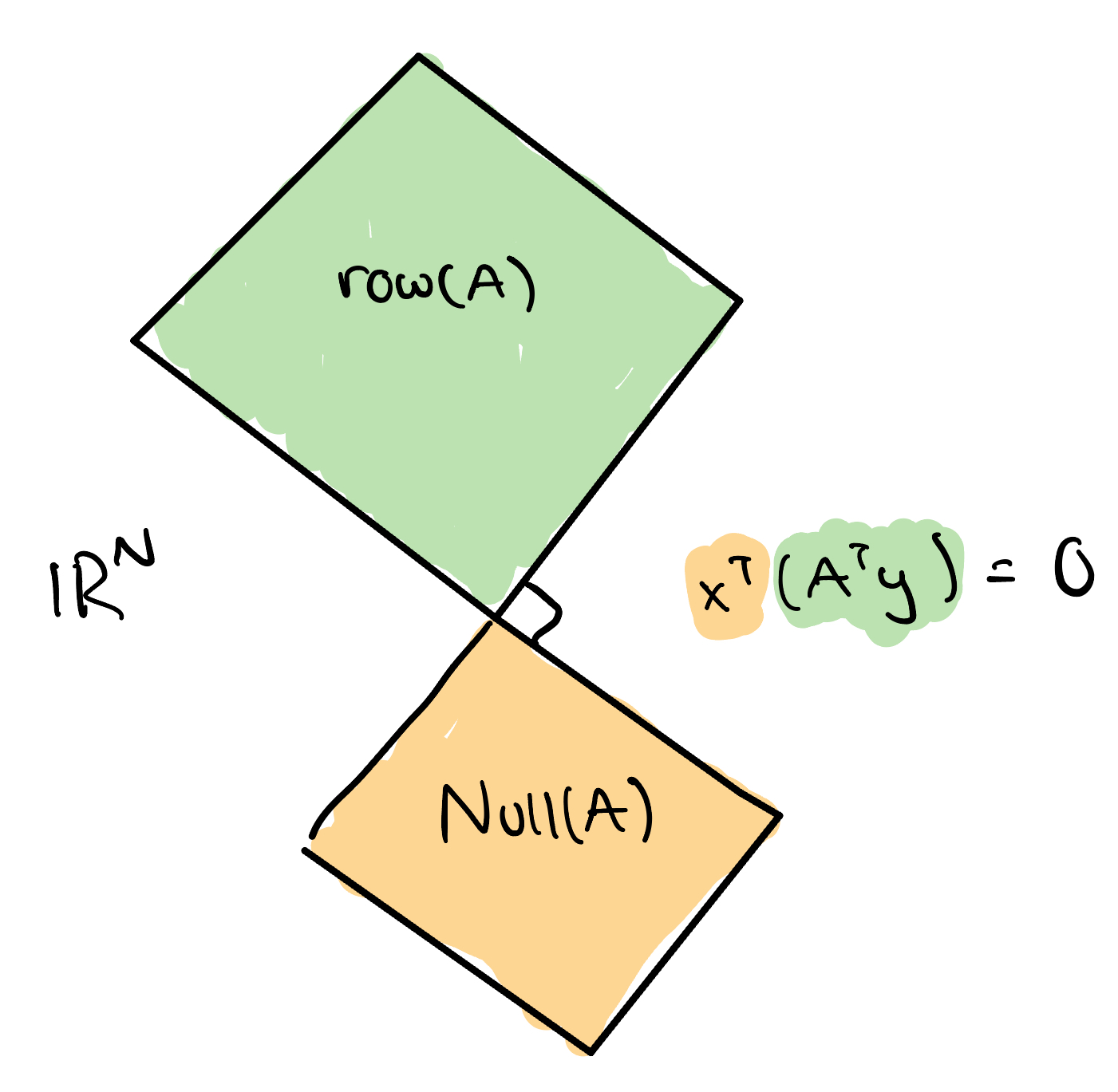
- If $\boldsymbol{x} \in \text{Null}(\boldsymbol{A}) $ and $\boldsymbol{z} \in \text{Row}(\boldsymbol{A}) $, then $\boldsymbol{x}^T\boldsymbol{z}=0$. In other words, any element in the null space of $\boldsymbol{A}$ is orthogonal to any element in the row space of $\boldsymbol{A}$. In this case, we say that $\text{Null}(\boldsymbol{A})$ and $\text{Row}(\boldsymbol{A}) $ are orthogonal complements of each other.
- Proof
Since $\boldsymbol{z} \in \text{Row}(\boldsymbol{A})$, let $\boldsymbol{z} = \boldsymbol{A}^T\boldsymbol{y}$ for some $\boldsymbol{y} \in \mathbb{R}^M$. Then,
- Proof
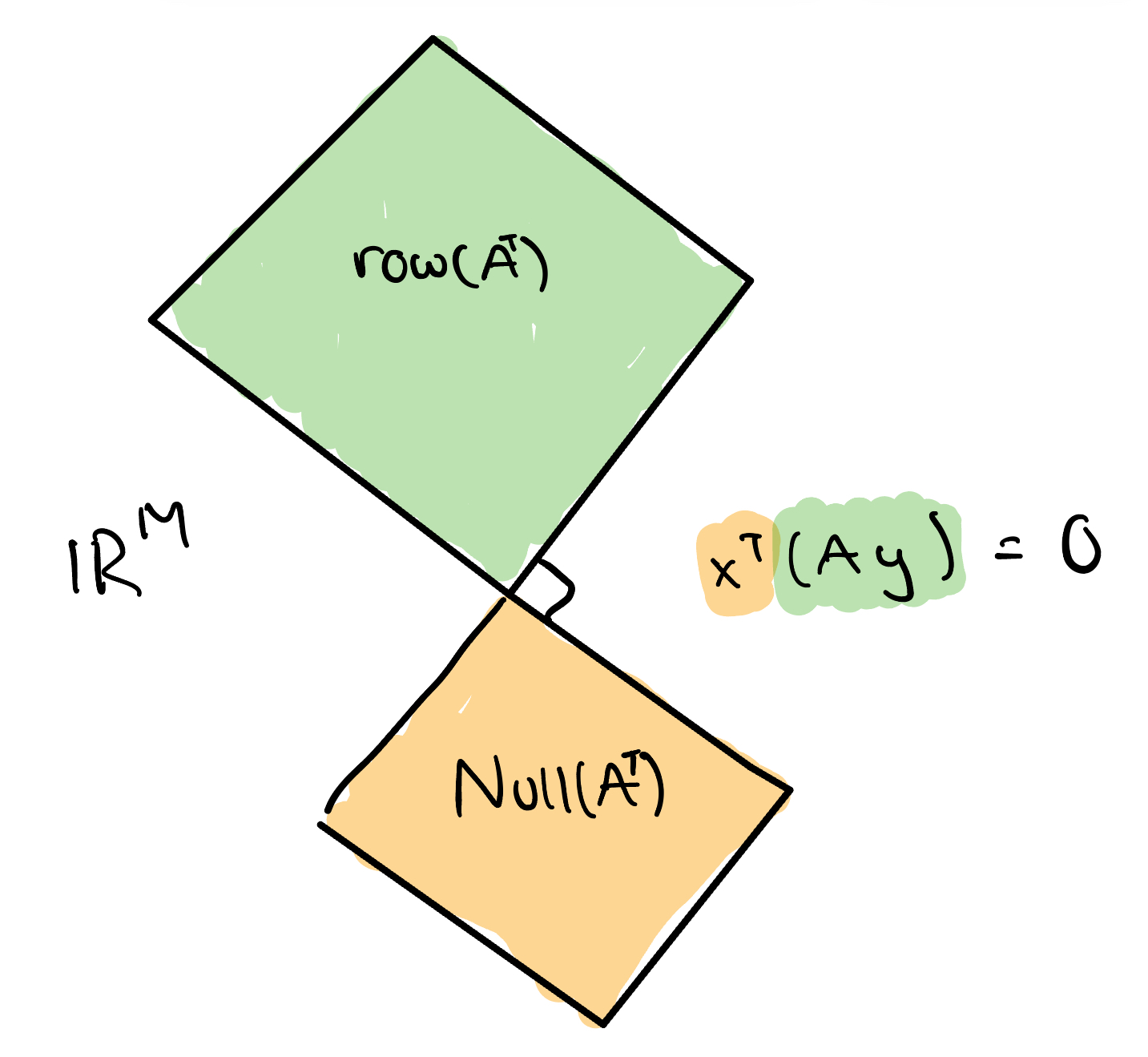
- If $\boldsymbol{x} \in \text{Null}(\boldsymbol{A}^T) $ and $\boldsymbol{z} \in \text{Col}(\boldsymbol{A}) $, then $\boldsymbol{x}^T\boldsymbol{z}=0$. In other words, any element in the left null space of $\boldsymbol{A}$ is orthogonal to any element in the column space of $\boldsymbol{A}$. In other words, $\text{Null}(\boldsymbol{A}^T)$ and $\text{Col}(\boldsymbol{A}) $ are orthogonal complements of each other.
- Proof
Since $\boldsymbol{z} \in \text{Col}(\boldsymbol{A})$, let $\boldsymbol{z} = \boldsymbol{A}\boldsymbol{y}$ for some $\boldsymbol{y} \in \mathbb{R}^N$. Then,
- Proof
Decomposition of $\mathbb{R}^N$ and $\mathbb{R}^M$
The rank-nullility theorem helps us decompose $\mathbb{R}^N$ and $\mathbb{R}^M$.
Let $\boldsymbol{A}$ be a $M \times N$ matrix. Then, $$ \text{dim}\big[\text{Null}(\boldsymbol{A})\big] + \text{dim}\big[\text{Row}(\boldsymbol{A})\big] = N $$
The rank nullility theorem allows us to decompose $\mathbb{R}^N$ into a union of two disjoint sets: the null space and the row space. As such, we can write any element of $\mathbb{R}^N$ as a sum of an element from the null space and an element from the row space:
The rank nullility theorem also lets us make a statement about $\boldsymbol{A}^T$:
\[\text{dim}\big[\text{Null}(\boldsymbol{A}^T)\big] + \text{dim}\big[\text{Row}(\boldsymbol{A}^T)\big] = M\]The corresponding decomposition for any element in $\mathbb{R}^M$ is:
These types of decompositions are used in finding minimum norm solutions to least squares problems.