Gaussian Integral
In this problem we are interested in the integral shown below. For convenience we will define the result of the integral as the variable $I$.
\[I = \int_{-\infty}^{\infty} e^{-x^2} \, dx \tag{1}\]We can instead consider the square of the integral.
\[\begin{aligned} I^2 &= \bigg(\int_{\mathbb{R}} e^{-x^2} \, dx \bigg)^2 \\\ &= \bigg(\int_{-\infty}^{\infty} e^{-x^2} \, dx\bigg)\bigg(\int_{-\infty}^{\infty} e^{-y^2} \, dy\bigg) \\\ &= \iint\limits_{\mathbb{R}^2} e^{-(x^2 + y^2)} \, dx\,dy \end{aligned}\]Since this integral is over the entirety of $\mathbb{R}^2$, we can alternatively parameterize the integral over the polar coordinates $r$ and $\theta$. The relationships between the variables are shown below.
\[\begin{aligned} x &= r \cos{\theta} &&& r^2 &= x^2 + y^2\\\ y &= r \sin{\theta} &&& \theta &= \text{atan2}(y, x) \end{aligned}\]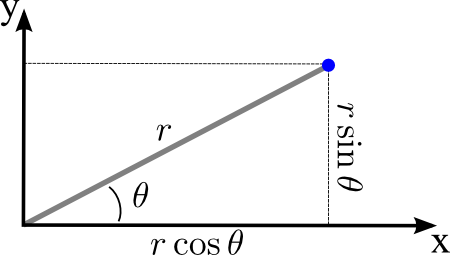
The differential area element in the rectangular and polar coordinates is given by the following expression. See the following figure for an illustration as to why a factor of $r$ appears.
\[\begin{aligned} dA = dx \, dy = r\,dr\,d\theta \end{aligned}\]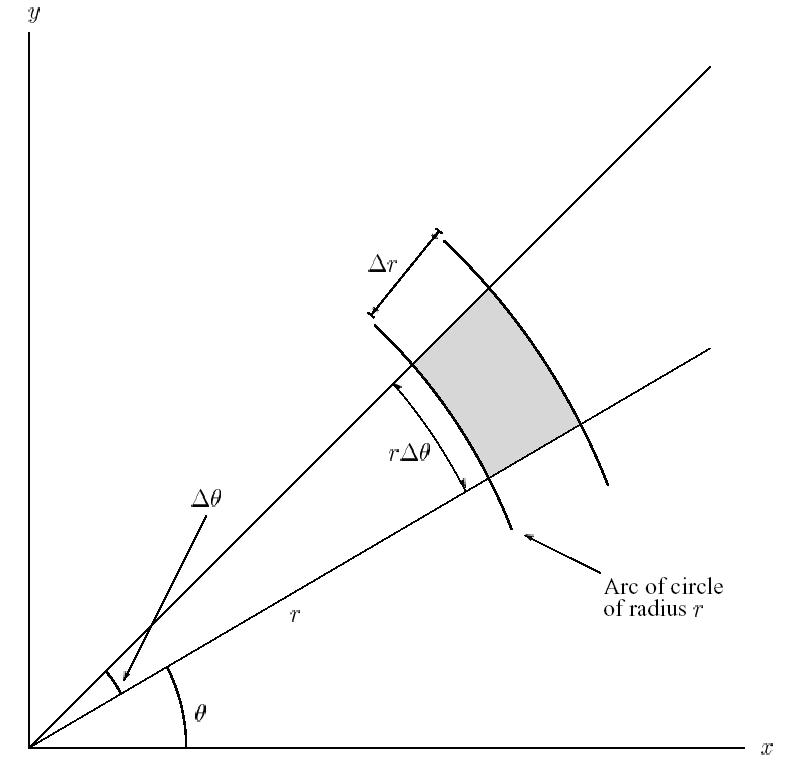
Using this change of variable our expression for $I^2$ now becomes the following,
\[\begin{aligned} I^2 &= \int\limits_{0}^{2\pi} \int\limits_{0}^{\infty} e^{-r^2} \,r\,dr\,d\theta \\\ &= 2\pi \Bigg[\frac{1}{2} \int\limits_{0}^{\infty} e^{-u} \, du\Bigg] \\\ &= \pi \end{aligned}\]Where the second line above is due to a u - substitution $ du = 2r\, dr $. Thus the gaussian integral is given by
\[I = \int_{-\infty}^{\infty} e^{-x^2} \, dx = \sqrt{\pi}\]